About Episode 3 of the Grefriars Reimagined Podcast
In today’s episode, Alex is talking to Joe Player of PRB Architects about the role of an architect in the Greyfriars project. This episode was recorded in early 2021. This podcast is part of Heritage Lincolnshire and City of Lincoln Council’s Greyfriars project, which aims to bring the Greyfriars building back into use. This project is funded by the National Lottery Heritage Fund, the Architectural Heritage Fund, the Pilgrims Trust and City of Lincoln Council.
Episode Transcript
[Music – ethereal female choral singing in Latin. Ecclesiastical style]
Laura Dunham
Hello all, welcome to the Greyfriars Reimagined podcast, where we explore the past and the future of Greyfriars Lincoln, one of the oldest Franciscan Friary buildings in England.
This podcast is part of Heritage Lincolnshire and City of Lincoln Council’s Greyfriars project, which aims to bring the Greyfriars building back into use.
This project is funded by the National Lottery Heritage Fund, the Architectural Heritage Fund, the Pilgrims Trust and City of Lincoln Council.
In today’s episode, Robin is talking to Joe Player of PRB Conservation Architects, about the architect’s role in the Greyfriars project. This episode was recorded in early 2021.
[Music – Violin and harp music accompanied by female singer singing in Latin. Sounds medieval in style]
Robin Eddows
Now then Joe, thanks for joining us. You have the leading conservation architectural role on the Greyfriars project.
Can you just tell us what that actually involves?
Joe Player
Yeah, so our role is to shepherd the design team, which involves others from structural engineers, mechanical and electrical consultants, principal designers who are responsible for health and safety as well as managing a team of other people who are going to be getting involved, especially at these early stages for a range of investigations.
And what that means is we’re here from start to finish to help deliver the project.
So we’re working closely with the project team, which is the City of Lincoln Council and Heritage Lincolnshire in partnership and amongst others including the funders from the National Lottery Heritage Fund and beyond, and to bring about the change in the buildings.
So we worked the RIBA plan of work which involves early stages scoping this project, making sure the briefs aligned with the client outcomes and the funding outcomes.
And taking that through concept design through the detailed design, statutory commissions in terms of in the instance of Greyfriars, it’s a Grade I listed building and it’s also a Scheduled Ancient Monument, so we’ve got dual consents to follow with in terms of planning to change the use, so his last use force the museum for the City of Lincoln which has been vacant for about 10 years, but we’ll be looking to bring that into a slightly different use for the future. And you’ve got Listed Building Consent, and you’ve got your Scheduled Ancient Monument consent.
Which are sort of three big gateways really, which will be where we’re heading towards the end of this year, after which is a bit of a pause for the funding, and then we go back and we look at the real detailed design and specification for the project works, and then we oversee the works on sites and the construction and throughout its life.
And then we’re also there beyond the end of the project once the contracts finished, to make sure that once it’s in use, it’s working as the end users want, which in this case it’s Heritage Lincolnshire, making sure that they can manage everything, they understand what controls are for the buildings and everything in between really.
So, it’s really a sort of hand holding exercise from start to finish and listening to everybody involved and making sure that we capture everybody voices everybody’s input. There’s a lot of people beyond.
There’s a lot more technical input required and bringing everything to bear to make sure that the project successful and it’s got on a sustainable footing for the future.
Robin Eddows
I gather that most of the structural inspection has now been completed. How did that go?
Joe Player
Good for what we can see. So, Greyfriars, it’s got really interesting history. Obviously, it’s been there for several hundred years. And as you can imagine over its lifetime, it’s changed quite a lot and there are some things we know and some things we don’t know. The results of, which is what we see today, and so we can only deal with what we’ve got. But what we have to try and do is work back from where we are today and understand how it’s changed to see where the changes have occurred that may cause potential issues that we can see.
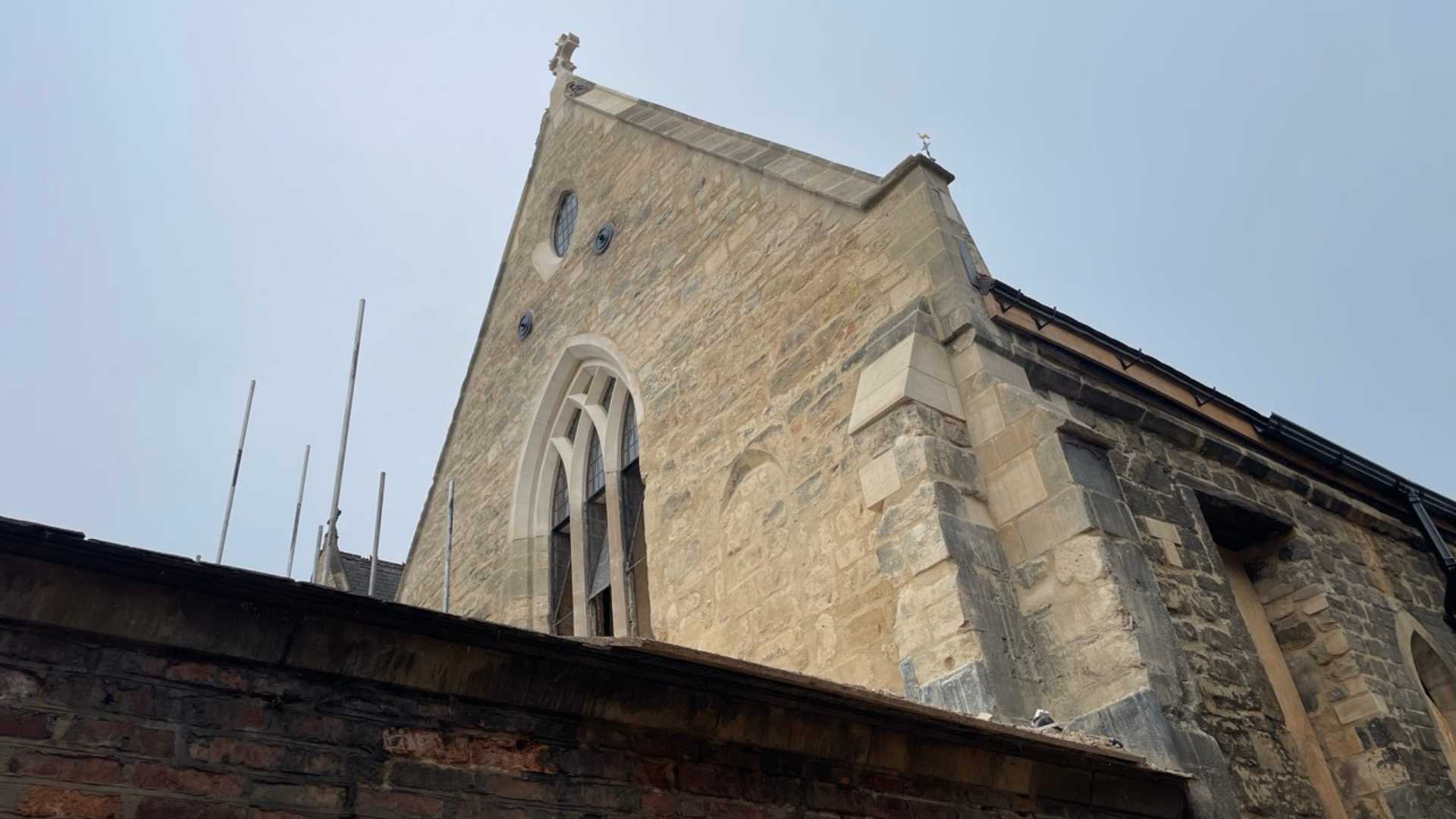
So one of the instances we can see is on the South elevation. If you if you’re walking along the Broadgate and you look up, you can actually see part of the wall plate projecting beyond the masonry line of the building, and that’s because the roof has actually spread ever so slightly. It’s nothing to worry about so that you can walk past. But it’s evidence that the building has moved. We know it’s been reroofed and perhaps on more than one occasion and there’s nothing to suggest it’s moving significantly, but it tells us that there is movement there.
Everything in terms of conservation is never a sort of knee jerk, “Oh my God, we found something that looks wrong. We must immediately fix it.” It’s understanding., is it in the state of equilibrium? You know, old buildings don’t just suddenly fall down. They’re wibbly and wobbly, but we love them for it and they’re there and because they are in a state of equilibrium, they behave very differently to modern buildings. So just because something doesn’t look perfect doesn’t mean it’s broken.
So, in this case it’s, and often is the case, it’s a sense of caution, really, and just to understand what you’re dealing with rather than rushing into something. So that’s reason why we go through these early investigations and the structural, the structural things we’ve seen today, there aren’t significant concerns. There are places where there’s evidence of movement which you’d expect. And there are places where we’ve got some open mortar joints, where we might need to do some repointing, but it’s nothing structural.
And there are areas where we can’t get to. So, what we did very early was to try and get as close as we could to the roof space inside to have a look at and inspect the timbers.
So, because it’s quite high volume, we’ve had a tower scaffold inside the first floor. Let’s try and get as close as we can, to see what we can because outside you can see sort of a bit of an undulating roofline. You can see some deflection, so there are areas where we know that there is water getting in and there’s there are issues historically. There’s nothing evident at the moment, but it’s where you’ve got evidence of that.
It suggests that there are perhaps latent defects that might need to be addressed, so until the roof is fully uncovered, we might not be able to get up close and actually touch everything millimeter to millimeter. But what it does give us is a very good close up visual inspection, as best we can do at this stage.
Robin Eddows
We were there a couple of weeks ago and the first thing I noticed was the tree was missing from the roof. I’m not sure how that’s helped your carbon footprint for the future.
Joe Player
It might have been holding the whole thing up, we don’t know.
[laughter]
Robin Eddows
It was quite significantly different because of that, but it must be, you know, with this being a Grade I listed building it must be incredibly difficult to sort of decide our repair strategy that you know one preserves the integrity of the building. But two takes it forward into the future, makes it safe for the future, and gives it some purpose.
So, I mean that must be a very, very difficult balancing act.
Joe Player
It really is, it really is.
And I think I must say this probably week in week out as to somebody somewhere or another is it’s all about the approach and for us, it’s got to be evidence led. There’s no point us running around the building and saying, “Oh my gosh, this thing needs to be completely re pointed.”
It’s often unnecessary. People do it because they don’t understand what they’re looking at, and we’re dealing with. So, the reason why we’ve approached it as we have is to get a range of investigations to understand: what’s essential? And what needs to be done to either address a problem, so in case of in the case of the roof for instance, or in case of open mortar joints, those sorts of things and what’s necessary to bring about positive change that we need, like as you say, to give it the sustainable footing for the future. To make the alterations, and then what’s necessary in terms of funding outputs.
So, the funding outputs, aren’t just linked to bringing the building back into use and giving the sustainable uses for the future, they’re also about community outcomes and social value, so an element of that budget has got to be assigned to interpretation, long term engagement, education and engagement and that’s throughout the life of the project.
So, all of these things are a big melting pot with a big budget. And we’ve got to try and prior set priorities. So, as I say, we always approach it on the basis of evidence of what’s essential. So what we need to do to make the change and what else we need to bring in in terms of the social, community and educational value?
And that’s always quite clear then. It gives you a guiding light and a bit of a North star to work towards and you’re not sort of necessarily trying to do too much, because ultimately there’s only so much money and it’s grant aided, and we’ve got to be responsible with where it’s spent.
Robin Eddows
It is very reassuring to know that money is available for this sort of you know, I mean to me, essential work, you know. It strikes me that what you got here is a sort of a Repair Shop meets Grand Designs you know and try to sort of try to match that. It’s very interesting and quite a difficult job to do.
Finally, one thing last thing to ask you. Something I noticed on my last visit: the toilet block around the back of the Greyfriars which to me is at least the brickwork they’ve used matching the brickwork on the library. And I assume they’ve actually built that at the same time.
But, to quote Prince Charles, it just seems a bit of a carbuncle to me on the side of the building and so then what plans you got for that you know?
Joe Player
Funnily enough it’s also the only place in the building that we’ve found asbestos at the moment, so we’re definitely backing out there.
But part of it’s the good old Victorians. They’re obviously they’ve obviously put this sort of extension on the back at the Moment which gives you the first-floor access. And yeah, the toilets at the ground floor and beyond that there’s this sort of modesty wall, which I think is the bit that’s sort of slightly contemporary or definitely erected in terms of with the library, but to sort of screen those toilets.
And yeah, absolutely it doesn’t help the setting of the building at all, I think. So, I mean, that’s part of building where when we do the assessment and we look at, there’s already a conservation management plan in place and a very, you know, really comprehensive document which outlines a lot of the history and how the asset should be managed and where it is more readily that we can make change.
So, when I say make changes is make alterations to the structure and because everything is covered by the listing and everything is covered by the schedule.
Robin Eddows
That’s great
Joe Player
Whatever we do to make change, it’s an area [the toilet block extension] where we’ve got more chance of making more change and actually, there are services, toilets, drainage and bits and pieces in that part of the site. If we can redevelop that, make better facilities for the new uses, it’s a better place to do it than trying to do it in the lovely ground floor space where we’ve got beautiful arches and all the rest of it.
Robin Eddows
Right, great. Thank you for that and so hopefully in the future you can sort of come back to the podcast and let us know how things are going.
But thank you, for that overview, it’s been very, very useful. Very informative.
You take care, thank you.
Joe Player
Yeah, you’re welcome. Anytime.
Thanks, Robin.
[Music – Violin and harp music accompanied by female singer singing in Latin. Sounds medieval in style]
Laura Dunham
Music was performed by soundLincs and Hildegard and recorded at Greyfriars.
If you would like to be notified when new episodes are released and to learn more about Heritage Lincolnshire’s work, please follow us on our social media, which are linked in the description or visit our website that you can also find below.
[Music, continued from previous – Violin and harp music accompanied by female singer singing in Latin. Sounds medieval in style][END OF RECORDING]