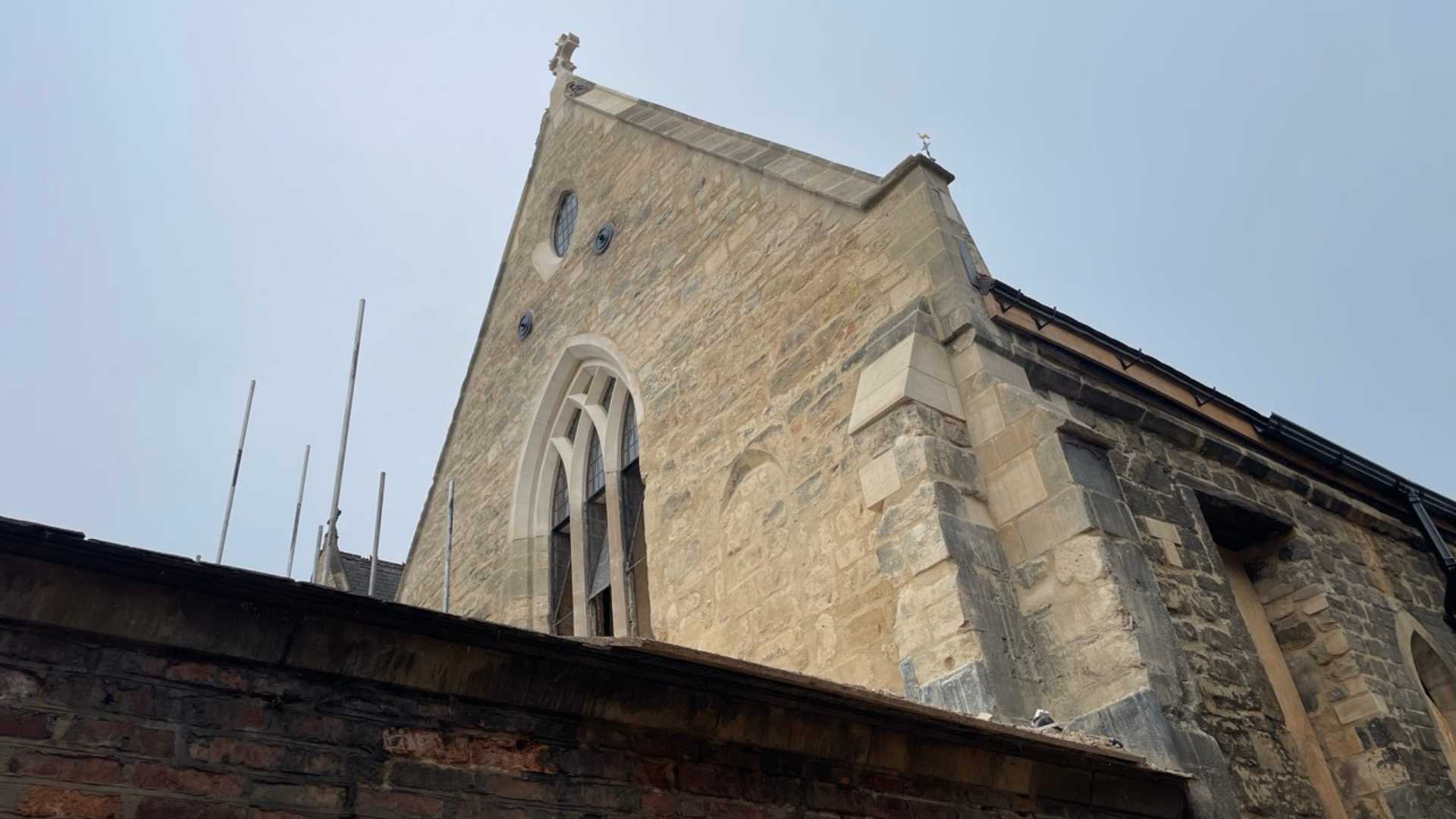
As part of the renovation of Greyfriars, we have been lucky enough to have some of the roof timbers sampled and taken for scientific analysis. This fascinating branch of tree science, known as dendrochronology, identifies the age of trees by studying their growth rings. The study of Greyfriars’ roof timbers was kindly facilitated by the Scientific Dating Team at Historic England in partnership with Nottingham Tree-Ring Dating Laboratory.
What is Dendrochronology?

Photo by Courtney Smith on Unsplash
Dendrochronology is often referred to as “tree-ring dating.” When trees grow, they form new cells in a layer near the bark. They grow faster at different times of year due to seasonal climate changes, so they leave a distinct growth ring roughly every year. You have probably seen a cross-section of a tree trunk showing several rings, each of which represents a year of the tree’s age.
Dendrochronology can also provide information on the climate and atmospheric conditions from different historic periods. Another more sophisticated method of determining the age of timber is known as isotope dendrochronology, which can measure the age of smaller pieces of wood where not all rings are present or visible. In heritage conservation, dendrochronology allows researchers to determine when trees were felled for construction. Since timber was typically used soon after felling, these dates can reveal when historic buildings were erected.
The Dendrochronological Study of Greyfriars Roof Timbers
Sixteen oak core samples were taken from different parts of the roof structure at Greyfriars, each labelled LIN-G01 to LIN-G16. The analysis successfully dated fourteen of these samples, providing a remarkable insight into the building’s medieval origins.
The results showed that most of the trees used in the construction were felled between AD 1222 and 1247, with a few slightly earlier examples dating to around AD 1203–1228. In archaeological terms, these are known as terminus post quem dates, which is Latin for “limit after which”, indicating the earliest possible date the timber could have been used.
This suggests that the roof timbers of Greyfriars, and likely much of the building we see today, were crafted from trees felled in the first half of the 13th century. It’s an extraordinary confirmation that the structure standing in Lincoln today has remained largely intact for over 750 years.
A Shared Woodland Source

Photo by Alex Larusso on Unsplash
The study also found that the samples from Greyfriars matched each other closely, suggesting that the timbers came from a coherent group of trees, probably from the same local woodland. This inter-site matching reveals not only when the trees were felled but also hints at where medieval builders sourced their materials.
Given Lincoln’s surrounding landscape at the time, which was rich in managed woodland, it’s likely that the oak came from a nearby forest, felled and shaped by local craftsmen for use in the friary’s construction. Interestingly, the analysis found no significant difference in date between the timbers used in the two distinct frame styles in the roof, meaning the structure was likely built in a single, well-planned phase rather than over several decades.
What This Means for Greyfriars’ Story
These findings help anchor Greyfriars firmly within the early decades of Lincoln’s medieval development. The 1220s–1240s were a period of religious expansion, when the Franciscan order known as the Grey Friars was establishing itself across England. The dating aligns perfectly with documentary evidence that the friary in Lincoln was founded in the early 13th century.
Through dendrochronology, we gain more than just dates. We gain a living connection to the craftsmen, the forests, and the climate of 13th-century Lincolnshire. Each ring in those ancient oaks tells part of that story, preserved in the very beams that still support the building today.
Looking Ahead
The results of this study not only confirm the historical authenticity of Greyfriars’ surviving structure but also enhance our understanding of medieval construction in Lincoln. As restoration work continues, studies like this remind us how scientific techniques can deepen our appreciation of heritage, bridging the gap between science, craftsmanship, and history.
The Greyfriars project continues to reveal extraordinary details about one of Lincoln’s oldest surviving buildings, and we look forward to sharing more discoveries as the restoration progresses.